Posted on

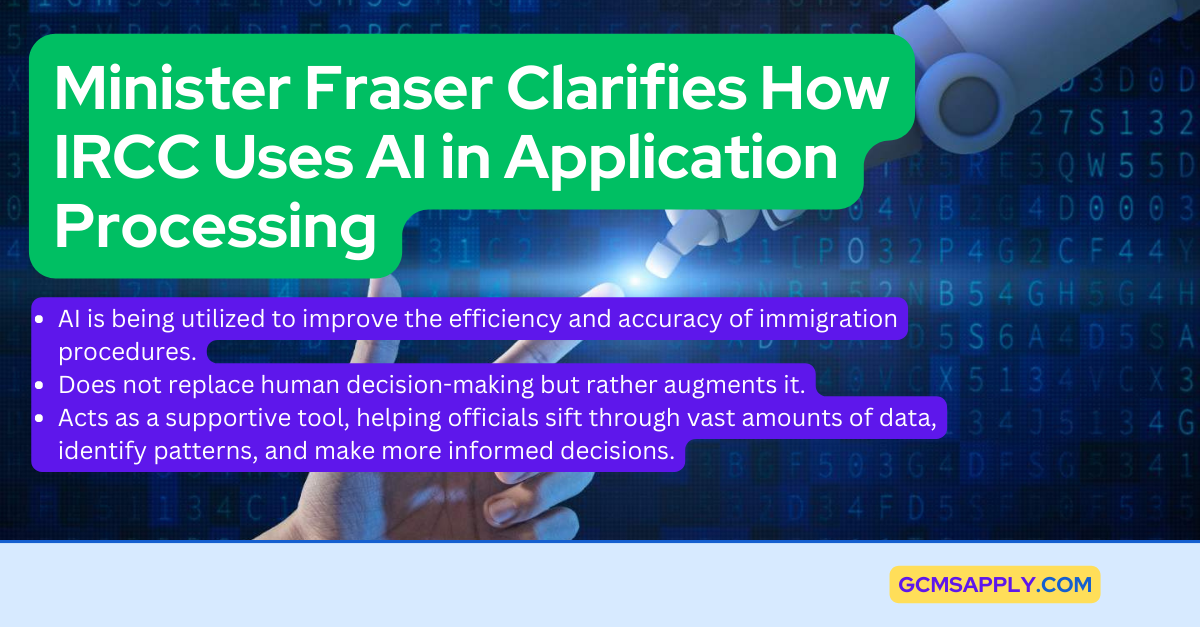
Minister Fraser Clarifies How IRCC Uses AI in Application Processing

Minister Fraser Clarifies How IRCC Uses AI in Application Processing

The Canadian government’s immigration department, Immigration, Refugees and Citizenship Canada (IRCC), has been harnessing the power of artificial intelligence (AI) to streamline and enhance its application processing system. In a recent announcement, Minister Fraser shed light on how AI is being utilized to improve the efficiency and accuracy of immigration procedures.

Traditionally, the immigration process has been a complex and time-consuming journey for both applicants and government officials. However, with the integration of AI technology, the IRCC aims to revolutionize the way immigration applications are handled, creating a more efficient and responsive system.

Minister Fraser emphasized that the use of AI in immigration processing does not replace human decision-making but rather augments it. The technology acts as a supportive tool, helping officials sift through vast amounts of data, identify patterns, and make more informed decisions.

One of the key advantages of incorporating AI into the immigration system is the ability to expedite processing times. AI algorithms can quickly analyze large volumes of applications, identifying potential issues or irregularities that require further attention. By automating certain tasks, such as document verification and risk assessment, the IRCC can accelerate the overall processing timeline, reducing wait times for applicants.

Moreover, the integration of AI ensures greater consistency and fairness in decision-making. Human bias, which can inadvertently influence judgments, is mitigated as AI systems rely on objective criteria and predefined rules. This ensures that applicants are evaluated based on their qualifications, skills, and eligibility, leading to a more transparent and equitable process.

In addition to efficiency gains, AI also strengthens security measures within the immigration system. The technology can effectively detect patterns associated with fraud, forgery, or identity theft, enabling officials to identify high-risk cases and allocate resources accordingly. By fortifying the system’s security, the IRCC aims to protect the integrity of the immigration process and maintain public trust.

Minister Fraser was quick to address concerns regarding the use of AI, emphasizing the government’s commitment to safeguarding privacy and maintaining strict data protection protocols. He stated that while AI technology requires access to personal data to perform its functions, the IRCC ensures that all data is handled in accordance with Canadian privacy laws and regulations. The privacy of applicants is a top priority, and robust measures are in place to prevent unauthorized access or misuse of sensitive information.

Looking ahead, Minister Fraser expressed the government’s ongoing commitment to harnessing AI’s potential to improve immigration services continually. The IRCC will continue to invest in research and development, working closely with industry experts and stakeholders to refine the AI systems and address any potential biases or limitations.

As the world rapidly evolves, AI presents a remarkable opportunity for the IRCC to enhance its processes and deliver a more efficient, transparent, and fair immigration system. The integration of AI technology promises to streamline application processing, reduce wait times, strengthen security measures, and ensure the integrity of Canada’s immigration system.

Read more: Understanding Chinook – The Tool Developed by IRCC to Simplify Visa Processing
Posted on

IRCC Announces New Selection Categories for Express Entry Candidates

IRCC Announces New Selection Categories for Express Entry Candidates

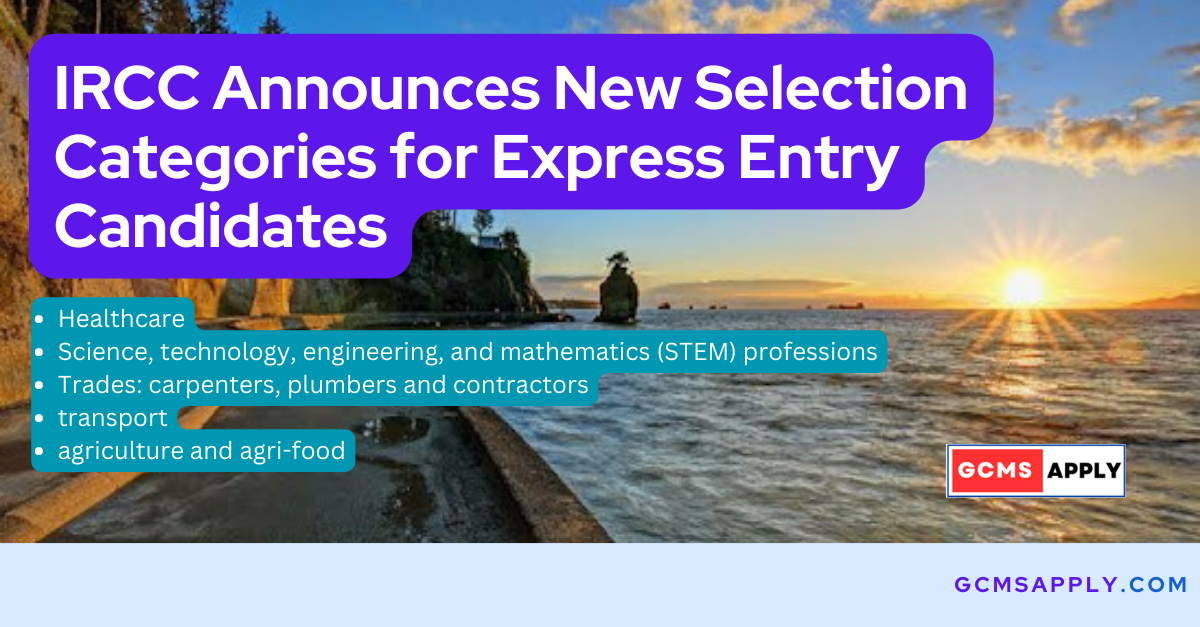
Canada’s Immigration Minister, Sean Fraser, has announced the launch of category-based selection draws for Express Entry candidates. Immigration Refugees and Citizenship Canada (IRCC) will be focusing on Express Entry candidates who have a strong French language proficiency or work experience in the following fields:

  1. Healthcare
  2. Science, technology, engineering, and mathematics (STEM) professions
  3. Trades, such as carpenters, plumbers and contractors
  4. Transport
  5. Agriculture and agri-food

The new selection categories are aimed at attracting skilled workers who can contribute to Canada’s economy and help fill labour shortages in these fields.

The new selection categories will be implemented through category-based selection draws for Express Entry candidates. The draws will be conducted on a regular basis and will focus on candidates who have a strong French language proficiency or work experience in the above-mentioned fields.

The new selection categories are part of the government’s ongoing efforts to attract skilled workers to Canada and help fill labour shortages in key sectors of the economy.

You can find a complete list of eligible occupations under the new categories here.

Posted on

Canadian Work Experience Requirement Removed for Engineers in Ontario

Canadian Work Experience Requirement Removed for Engineers in Ontario

In a significant development for engineers in Ontario, the provincial government has made a crucial policy change by eliminating the Canadian work experience requirement. This landmark decision is expected to create new opportunities for foreign-trained engineers seeking employment in the province. In this post, we’ll delve into the details of this news and discuss the implications for engineers aspiring to work in Ontario.

The Ontario provincial government recently announced a major policy change that is set to benefit foreign-trained engineers. As per the new regulations, the requirement for Canadian work experience has been removed, opening up opportunities for engineers from around the world to secure employment in the province.

Previously, foreign-trained engineers faced significant barriers when attempting to work in Ontario. The requirement of Canadian work experience often made it challenging for these highly skilled professionals to find suitable employment. This policy change aims to address this issue and make the province more accessible for internationally educated engineers.

The elimination of the Canadian work experience requirement is expected to have several positive implications. Firstly, it will attract a larger pool of skilled engineering professionals to Ontario, enhancing the diversity and talent within the province’s engineering sector. This influx of international expertise can lead to innovative solutions and advancements in various industries.

Moreover, this change will not only benefit the engineers themselves but also the province’s economy as a whole. Ontario relies heavily on engineering expertise across sectors such as manufacturing, construction, and technology. By removing the work experience barrier, the government is fostering a more competitive and inclusive job market, ultimately contributing to economic growth.

It’s worth noting that while the Canadian work experience requirement has been eliminated, other criteria, such as education and language proficiency, still apply. Foreign-trained engineers will still need to meet the standards set by the province’s engineering regulatory body, which evaluates qualifications and grants licenses to practice engineering in Ontario.

Foreign engineers interested in working in Ontario should ensure they fulfill the necessary educational requirements and possess the required language proficiency. They can then proceed with the licensing process, which involves submitting the appropriate documentation and passing the examinations conducted by the regulatory body, Professional Engineers Ontario (PEO).

In conclusion, the removal of the Canadian work experience requirement for engineers in Ontario marks a positive step towards attracting international talent and promoting a more inclusive job market. This change provides foreign-trained engineers with an equal opportunity to contribute their skills and expertise to the province’s flourishing engineering sector. By embracing diversity and talent from around the world, Ontario is poised to benefit from innovative solutions and further economic growth in the years to come.

Posted on

IRCC Approves Four New English Language Tests for Student Direct Stream

IRCC Approves Four New English Language Tests for Student Direct Stream

Introduction

The Canadian government has recently made an important announcement that is set to benefit international students applying through the Student Direct Stream (SDS) program. The Immigration, Refugees and Citizenship Canada (IRCC) has approved four additional English language tests for SDS applicants. This move aims to enhance accessibility and provide more options for prospective students to prove their language proficiency. In this blog post, we will explore the significance of this decision and its potential impact on international students aspiring to study in Canada.

Expanding Options for Language Proficiency Assessment

Previously, the IRCC only accepted the International English Language Testing System (IELTS) for language proficiency assessment. While IELTS is a widely recognized and respected test, the addition of four new English language tests under the SDS program will provide students with greater flexibility. The newly approved tests are the Test of English as a Foreign Language (TOEFL), the Canadian English Language Proficiency Index Program (CELPIP), the Pearson Test of English Academic (PTE Academic), and the Cambridge English: Advanced (CAE).

Benefits for International Students

  1. Increased Accessibility: The inclusion of these additional language tests will significantly improve accessibility for international students. Previously, many students had limited access to IELTS testing centers or found it challenging to prepare for this specific exam. The approval of alternative tests provides a more diverse range of options that cater to different learning styles and individual circumstances.
  2. Familiarity and Adaptability: By accepting widely recognized English language tests, the IRCC acknowledges the credibility and reliability of these alternative assessments. Students who have already taken one of the newly approved tests for other purposes, such as admission to an educational institution, can now utilize their existing scores for their SDS application. This streamlines the process and eliminates the need for students to retake an English language test.
  3. Improved Language Assessment Tools: Each of the newly approved tests offers unique features and evaluation methods. This diversity in testing methods provides students with the opportunity to choose a test that aligns with their strengths and preferences. For example, some students may find the computer-based format of PTE Academic more comfortable, while others may prefer the paper-based format of TOEFL. This variety allows applicants to showcase their language skills effectively.
  4. Quicker Application Processing: The Student Direct Stream program aims to expedite the processing time for study permit applications. By accepting multiple English language tests, the IRCC reduces the burden on testing centers and allows for a smoother application process. This change is expected to contribute to faster decision-making and enable students to begin their studies in Canada sooner.

Conclusion

The IRCC’s decision to approve four new English language tests for the Student Direct Stream program is a welcome development for international students. By expanding the range of accepted tests, the Canadian government demonstrates its commitment to inclusivity, accessibility, and adaptability in the education system. This change will benefit prospective students by providing them with more options to showcase their English language proficiency. As Canada continues to attract students from around the world, this decision ensures that language proficiency requirements align with the diverse needs of international applicants.

Posted on

Canada Announces New Open Work Permit for Family Class and Spousal Applicants

Canada Announces New Open Work Permit for Family Class and Spousal Applicants

Introduction

In a welcome move for individuals seeking to reunite with their families in Canada, the Canadian government has recently announced a new policy to introduce an open work permit for family class and spousal applicants. This initiative aims to facilitate the immigration process and provide greater opportunities for family members to work while residing in Canada. Let’s delve deeper into the details of this new policy and its potential impact.

New Policy Details

On May 27, 2023, Canada’s government announced the introduction of an open work permit for family class and spousal applicants. This policy allows individuals who are in the process of sponsoring their spouse or common-law partner, as well as parents and grandparents, to obtain an open work permit while their application is being processed. The open work permit will enable them to work for any Canadian employer and gain valuable Canadian work experience during this period.

Benefits for Applicants

The introduction of the open work permit for family class and spousal applicants brings several benefits. Firstly, it allows individuals to be reunited with their loved ones in Canada while they await the outcome of their sponsorship application. This helps reduce the stress and emotional burden of being separated from family members during the immigration process.

Moreover, the open work permit provides individuals with the opportunity to support themselves financially and contribute to the Canadian economy. By being able to work for any employer in Canada, family class and spousal applicants can explore job opportunities that align with their skills and qualifications, thus enhancing their professional growth.

Benefits for Canada

The new open work permit policy aligns with Canada’s commitment to family reunification and supporting immigrants’ successful integration into Canadian society. By allowing family class and spousal applicants to work, Canada acknowledges the importance of their contributions to the country’s economy and social fabric.

The policy also addresses labor market needs in certain sectors by providing Canadian employers with access to a diverse pool of talent. By welcoming skilled individuals who are waiting for their sponsorship applications to be processed, the open work permit facilitates the filling of job vacancies, contributing to economic growth and reducing labor market gaps.

Enhanced Opportunities for Permanent Residency

In addition to the immediate benefits of reuniting with family and gaining work experience, the open work permit for family class and spousal applicants also enhances their prospects for obtaining permanent residency in Canada. Canadian work experience is highly valued when assessing applicants for immigration programs, such as the Canadian Experience Class (CEC) and the Provincial Nominee Program (PNP). The open work permit allows individuals to accumulate valuable work experience, which can significantly strengthen their immigration profile.

Conclusion

Canada’s new policy of introducing an open work permit for family class and spousal applicants is a significant step towards facilitating family reunification and supporting immigrants in their journey to establish themselves in Canada. By granting individuals the opportunity to work and contribute to the Canadian economy, this policy demonstrates the country’s commitment to inclusivity and integration.

The open work permit not only provides immediate benefits for family members waiting for their sponsorship applications but also enhances their long-term prospects for permanent residency. As Canada continues to prioritize family reunification and the economic well-being of immigrants, this policy will undoubtedly play a crucial role in shaping a more vibrant and diverse society.

References:

  1. Canada announces new open work permit for family class and spousal applicants. (2023, May 27). Business Today. Retrieved from https://www.businesstoday.in/latest/in-focus/story/canada-announces-new-open-work-permit-for-family-class-and-spousal-applicants-383091-2023-05-27